

Neuromorphic engineering for real-world applications
About the International Centre for Neuromorphic Systems
Our aim is to perform world-leading research to develop neuromorphic sensors, algorithms, and processing hardware, and apply these to solve problems in modern society.
Our mission is rooted in a three-tiered approach to neuromorphic technology development – encompassing sensing, algorithms, and hardware platforms – and is driven by real-world applications that not only guide our research but also approach to solutions. This integrated focus defines and enables impactful solutions.
Design high‑performance, low‑power sensing and processing for autonomous systems.

Develop brain‑inspired neural networks outperforming traditional computing and sensing systems.

Train and equip the next generation of neuromorphic engineering specialists.

The International Centre for Neuromorphic Systems exemplifies the University of Manchester’s ambition to lead globally at the intersection of fundamental research, engineering excellence, and real‑world impact. By bringing together world‑leading expertise across disciplines and sectors, ICNS will accelerate responsible innovation in neuromorphic technologies and help address some of the most complex engineering and societal challenges of our time.
Professor Duncan Ivison / President and Vice Chancellor of The University of Manchester
Our research
Leveraging neuromorphic technologies to deliver superior solutions to pressing challenges
Historically, neuromorphic systems have evolved within a niche research community, largely overlooked due to the dominance of Moore’s law and the rapid advancement of conventional electronics. However, as Moore’s law reaches its limits, interest from industry and defence sectors in neuromorphic engineering has surged. ICNS is ideally positioned to lead this transformation, leveraging its legacy, expertise and international collaborations to ensure that neuromorphic engineering moves beyond hype to become a foundational technology for the future.
The Centre set in the heart of The University of Manchester's Faculty of Science and Engineering. Building upon decades of experience in Computer Science from the first electronically stored program to the SpiNNaker system which offers real-time brain modelling, the Centre focuses on application of fundamental principles of neuromorphic engineering in real world challenges through cross disciplinary application of Neuroscience, Electronic Engineering and Computer Science.
With assets like SpiNNaker and SpiNNaker2, long‑standing expertise in computer architecture, and strong neuroscience and engineering research, Manchester is one of the few places globally with the full stack needed to push neuromorphic engineering into real‑world deployment.

Our research focus
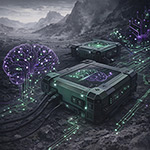
Algorithms
Using techniques such as spiking neural networks and brain inspired architecture, we produce low energy systems that can be deployed in harsh environments.
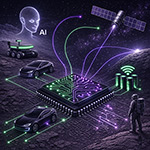
Applications
Leveraging leading research into neuromorphic engineering and algorithms we can solve real world challenges which traditional methods struggle to solve.
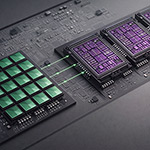
Processors
Creating massively parallel SIMD processor arrays allows us to deploy the chips right next to the sensors producing huge gains as seen in our Scamp system.

Sensors
Neuromorphic systems can operate with both conventional sensors and event-driven sensors. Event-driven sensors like DVS enable the handling of sparse data, which eases the load on processing pipelines.
Projects
- Project team: Davide Bertozzi (Lead), Ed Jones, Oliver Rhodes
- Funder: EU Horizon Europe / UKRI
- Timeframe: October 2024 - September 2027
- Partners: IHP Microelectronics (Germany), University of Ferrara (Italy), University of Nis (Serbia)
AIDA4Edge explores efficient edge AI by combining neuromorphic vision with a hybrid event-processing pipeline. It uses a Spiking Neural Network (SNN) for fast, low-power ROI detection in event streams, forwarding only selected regions to an Artificial Neural Network (ANN) for advanced analysis. By focusing the ANN on essential segments, computational costs and energy use are minimized, supporting scalable, real-time applications in robotics and smart sensing.
- Project team: Davide Bertozzi (Lead), Andrew Rowley
- Funder: EU
- Timeframe: January 2024 - December 2026
- Partners: 59 institutions across the UK and EU
EBRAINS 2.0 is a European initiative advancing digital neuroscience through an integrated platform of data, tools, and computing services. Building on the Human Brain Project, it supports research across molecular to whole-brain scales using multiscale modelling and data integration. Features include digital brain twins, advanced simulations, high-performance computing, and AI analytics. EBRAINS 2.0 promotes collaboration, standardized workflows, and FAIR data to enable reproducible, scalable research.
- Project team: Basab Bhattacharya, Oliver Rhodes (Lead)
- Funder: EPSRC
- Timeframe: July 2024 - October 2027
- Partners: Universities of Cardiff, Southampton, Stirling and York.
Edgy Organism explores novel design methodologies, neural network architectures, and efficient neuromorphic hardware systems for autonomous monitoring and alerting in uncertain environments based on patterns of life.
A novel end-to-end neuromorphic design approach based on spiking neural networks (SNNs) is being developed, drawing inspiration from how data is processed and represented in the brain. Low power and small form factor requirements will be met by targeting the cutting-edge Intel Loihi2 hardware platform (hosted at The University of Manchester).
- Project team: Alexander Heazell, Jayawan Wijekoon (Lead), Lisen Zhu
- Timeframe: 2012 - ongoing
- Partners: Tommy’s, the pregnancy and baby charity
Stillbirth affects around 1 in 200 UK pregnancies. Early foetal stress signs, such as reduced movements and heart rate changes, are often missed due to subjective, manual monitoring. This project develops a non‑invasive wearable vest to continuously measure foetal ECG, movement and maternal activity, enabling objective remote monitoring, earlier intervention, and improved understanding, prediction and prevention of stillbirth.
- Project lead: Oliver Rhodes
- Funder: EU Horizon Europe
- Timeframe: September 2022 - March 2026 (Completed)
- Partners: Led by Ikerlan, Spain, with 20 partners across Europe
Demonstrate novel event-based vision technologies in an integrated digital architecture to improve usability, energy-efficiency and performance in next-generation AI chips.
The University of Manchester component of the project explores algorithms for guiding foveated sensing to improve efficiency, together with their implementation in hardware allowing real-time near-sensor computing.
Our team and partners
Meet our team
The Centre is made up of a core team of academics and researchers who provide critical expertise to our research portfolio. Each person brings a distinct field of study – such as neuromorphic sensing, neuromorphic algorithms, computing hardware design, verification and security and applications spanning remote environments, Industry 4.0, and healthcare – ensuring we have the capability and depth of expertise needed to address both research and industry challenges.
Davide Bertozzi - Reader in Advanced Processor Technology
Davide's research focuses on system innovation through communication architectures and emerging technologies, particularly interconnect-centric design and networks-on-chip. His work spans large-scale EU and national projects, silicon photonics for computer communications, and electro‑optical interconnection fabrics for 3D‑stacked systems, with around 180 scientific publications in the field.
Georgios Detorakis - Lecturer in Neuromorphic Systems
Georgios's research focuses on neuromorphic computing, neuroscience, machine learning, and control theory. He explores continual learning, motor control, and sensorimotor integration and their applications within neuromorphic systems and biomedical applications.
Piotr Dudek - Professor of Circuits and Systems
Piotr's research interest is in integrated circuit design, especially vision sensors, cellular processor arrays, analogue and mixed-mode processing hardware, neuromorphic engineering and brain-inspired systems.
Alexandre Marcireau - Lecturer in Neuromorphic Systems
Alex joined the Centre in 2025. His research focuses on bio-inspired computer vision, event vision sensors, event-based processing, and software development.
Luca Peres - Lecturer in Low Energy Computation and Novel Technology
Luca obtained his PhD in computer science in 2022 at The University of Manchester exploring real-time simulations of large scale biologically-representative spiking neural networks on neuromorphic hardware. He then continued for a postdoctoral position in the Department of Computer Science, working on event-driven sensing and processing for computer vision in the scope of edge applications. Luca’s main interests are in low-power sensing and processing, with focus on event-based sensor fusion applications and in-sensor and near-sensor computing. In addition, Luca is interested in exploring novel biologically-inspired architectures with the intent of producing more reliable and low-power systems aiming to overcome the von Neumann bottleneck.
Oliver Rhodes - Senior Lecturer in Bio-inspired Computing
Oliver's research explores neuromorphic systems for AI and computational neuroscience applications. The research combines components of machine learning, neuroscience, and computer architecture, with the goals of furthering our understanding of the brain, and developing next-generation computing systems.
André van Schaik - Centre Director and Furber Chair in Neuromorphic Systems Engineering
André van Schaik received an MSc in Electrical Engineering from the University of Twente, Enschede, The Netherlands, in 1990 and a PhD in Electrical Engineering from the Swiss Federal Institute of Technology (EPFL), Lausanne, Switzerland, in 1998. He has authored more than 350 publications, invented more than 35 patents, and is a founder of four start-up companies: VAST Audio, Personal Audio, Heard Systems, and Optera Solutions.
He was the Director of the International Centre for Neuromorphic Systems at Western Sydney University from 2018 to 2024, and is the current Director of our new Centre in Manchester. His research focuses on neuromorphic engineering and computational neuroscience.
Jayawan Wijekoon - Lecturer in VLSI Design
Jayawan’s research interests include brain-inspired computing architecture for cognitive systems and bio-inspired sensors, low power wearable electronic solutions for medical applications and development of novel neural elements in plastic electronic technology. One of his publications awarded the Best Paper award from the IEEE and INNS at IJCNN conference, USA. His past and present research collaborations include multi-disciplinary research groups from various academic institutions, hospitals, and companies from wearable and biomedical industries.
The Centre is supported by a strong cohort of PDRFs and PDRAs and currently hosts dedicated PhD students engaged in both learning and research within Neuromorphic Engineering and Systems. Their projects reflect the breadth of the Centre’s expertise and contribute to the development of a diverse and skilled core team. Additional information regarding these individuals and their research activities will be made available in the coming months.
Our partners
-

Western Sydney University
ICNS Manchester is partnered with our international sister in Western Sydney University in Australia. This partnership makes ICNS truly internationally focused offering a far wider access to expertise in both UK and Australia.
Visit the WSU website
-
Optera
The Centre and Optera Ltd are closely connected, with Optera emerging as a spin-out from the Centre’s research at Western Sydney University - translating our impactful work into real-world advances in Space Domain Awareness.
Visit the Optera website
-
Cambridge x Manchester
The Cambridge × Manchester Partnership is a UKRI funded collaboration between Cambridge and Manchester Cities. The aim is to build greater links between the two universities and businesses in both cities. Neuromorphic systems and engineering is a core theme being explored as part of this project.
Visit the Cambridge x Manchester website
-
CHIMES
The Innovation and Knowledge Centre for Heterogeneous Integration of MicroElectronic and Semiconductor Systems (CHIMES) is a national Innovation and Knowledge Centre (IKC), established under the UK's National Semiconductor Strategy. CHIMES’s mission is to unify the UK’s electronics ecosystem, connecting the country's world-class design community and science base with clear pathways to manufacture.
Visit the CHIMES website
-
Neuroware
The UK Innovation & Knowledge Centre in Neuromorphic Computing (NeuroWare) is accelerating the development of brain-inspired computer hardware.
Visit the Neuroware LinkedIn page



Contact us
Get in touch
Interested in collaborating or want to learn more about the Centre’s work? Get in touch at icns@manchester.ac.uk or follow us on LinkedIn.
Exploring postgraduate research opportunities? Discover our projects on FindAPhD.